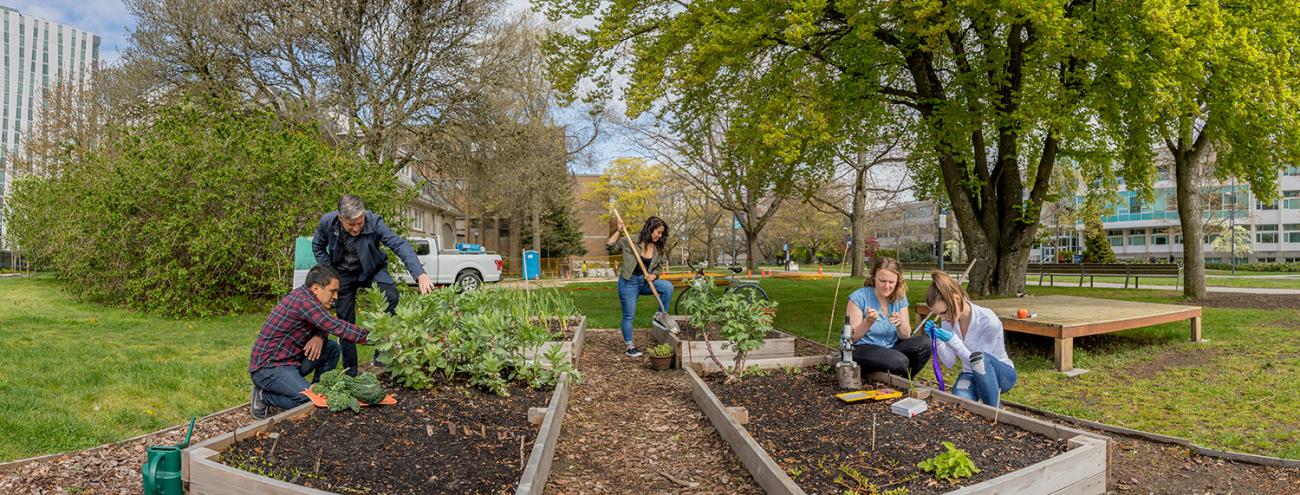
The SEEDS (Social Ecological Economic Development Studies) Sustainability Program is one of UBC’s flagship Campus as a Living Laboratory initiatives and the dedicated research and development (R&D) arm within Sustainability & Engineering, Campus + Community Planning. Launched in 2001, SEEDS helps inform the development and implementation of UBC’s operational sustainability and engineering plans through applied student research that uses the campus as a testbed for innovation.
Mandate and research priorities
SEEDS’ mandate is to utilize the campus as a living laboratory to co‑create impactful student research opportunities and interdisciplinary partnerships that advance UBC’s sustainability and wellbeing goals while informing operational plans and policies. The program focuses its work through five “Big 5” research priorities: accelerating climate action, maintaining and enhancing urban biodiversity, enabling the great food transformation, creating circular and regenerative economies, and fostering community wellbeing and inclusion. These priorities guide SEEDS’ portfolio of projects and partnerships with operational units, academic departments, and community partners, ensuring that research is aligned with UBC long term sustainability goals.
Collaboration and research pathways
SEEDS operates through a collaboration and research model that convenes faculty, students and staff on campus‑wide initiatives, committees, and action teams in areas such as biodiversity, food systems, procurement, circular economy, and zero waste to co‑identify challenges and co‑develop solutions. Through this model, SEEDS connects faculty, students, staff, and community partners to generate applied research that is directly embedded in UBC’s planning and operational processes. Research is advanced through two primary pathways: a curricular pathway that integrates SEEDS projects into directed studies, regularly offered courses, and undergraduate or graduate theses or major projects; and a co‑curricular pathway that engages paid undergraduate and graduate research assistants in dedicated SEEDS projects.
Measuring impact: research to policy and practice
SEEDS evaluates its work through an impact framework focused on three core functions: catalysing action, convening and connecting, and co‑creating experiences. It tracks how research and collaborations influences decision‑making and practice, including the ways in which it helps inform and implement UBC plans and policies—such as the UBC Climate Action Plan 2030 and the Green Building Action Plan—as well as operational changes resulting from SEEDS research. The program also measures the applied research opportunities it generates, the community‑based partnerships it sustains, and the knowledge‑exchange activities it hosts, drawing on surveys, partnership debriefs, committee and working group records. SEEDS contributes to learning outcomes, skills development, capacity and network building, and the continuity of relationships and partnerships over time.
The program has catalysed concrete actions across food systems, circularity, and biodiversity, earning international recognition with its model replicated across universities in North America and Europe. This enduring program demonstrates how campus-based living lab can drive meaningful sustainability transformation over decades of sustained collaboration.
Learn more about SEEDS Sustainability Program.